A scratch on your paint feels worse than it looks, and many scratches can be removed at home without a body shop. I’m a serious DIYer, and the repair that taught me the most was a scratch on the passenger-side rear quarter panel of a dark blue Honda Civic. Dark paint shows every swirl and haze mark, so it is an unforgiving place to learn. Backed by paint care and surface repair insights from industry specialists like //www.autonags.com/, this guide covers what I did, what I’d do again, and the questions people ask most.
Quick answer: how do you buff out a scratch on a car?
- Wash and decontaminate the surface.
- Check how deep the scratch is with the fingernail test.
- Tape off nearby trim and panel edges.
- Test the least aggressive compound and pad on a small spot.
- Polish by machine or by hand with light pressure, in small overlapping passes.
- Wipe the area with a 50/50 isopropyl alcohol and water mix to see the real result.
- Repeat up to two or three times, then stop.
- Finish with a fine polish and protect the paint with wax or sealant.
That only works if the scratch is in the clear coat, so the first job is finding out how deep yours is.
Step 1: Find out how deep the scratch is
Modern car paint has layers: primer, a color coat, and a thin clear coat on top. Buffing removes a tiny amount of clear coat to level the surface around the scratch, so it only works on scratches that haven’t gone through it.
Use the fingernail test. Drag a fingernail lightly across the scratch.
- Your nail doesn’t catch: it’s a light surface scratch or swirl. Polishing should handle it.
- Your nail catches slightly: it’s in the clear coat and may be close to the color layer. This is usually still fixable, and it’s what I found on the Civic.
- Your nail catches hard, or you see a different color: it’s through the clear coat. If you see white, gray, or bare metal, buffing won’t fix it. You need touch-up paint or a professional.
A quick extra check is to wet the scratch with water. If it nearly disappears while wet, it’s likely shallow and in the clear coat, because water temporarily fills it in.
Step 2: Wash and decontaminate first
This was the first thing I did on the Civic, and I would never skip it. Polishing over dirt or bonded grit drags it across the paint and creates new scratches.
- Wash the whole panel with a proper car shampoo and a clean wash mitt.
- Dry it with a clean microfiber towel.
- Use a clay bar or clay mitt with lubricant to pull off embedded contamination. Clay doesn’t remove scratches, but it gives your pad a clean surface to work on.
Step 3: What you need
- Dual-action (DA) polisher, or foam applicator pads for hand work
- Medium-cut foam pad and a soft finishing pad
- Fine cutting compound and a fine finishing polish
- Painter’s tape
- Several clean microfiber towels
- Isopropyl alcohol mixed 50/50 with water in a spray bottle
- Wax or paint sealant
- A strong light, such as a flashlight or inspection light
Step 4: Tape off edges and test a small spot
Paint is thinnest on panel edges and body lines, so tape them off before you start. Then pick a small test area and use the least aggressive combination first. You can always step up to something stronger, but you can’t put clear coat back.
Step 5: Buff the scratch
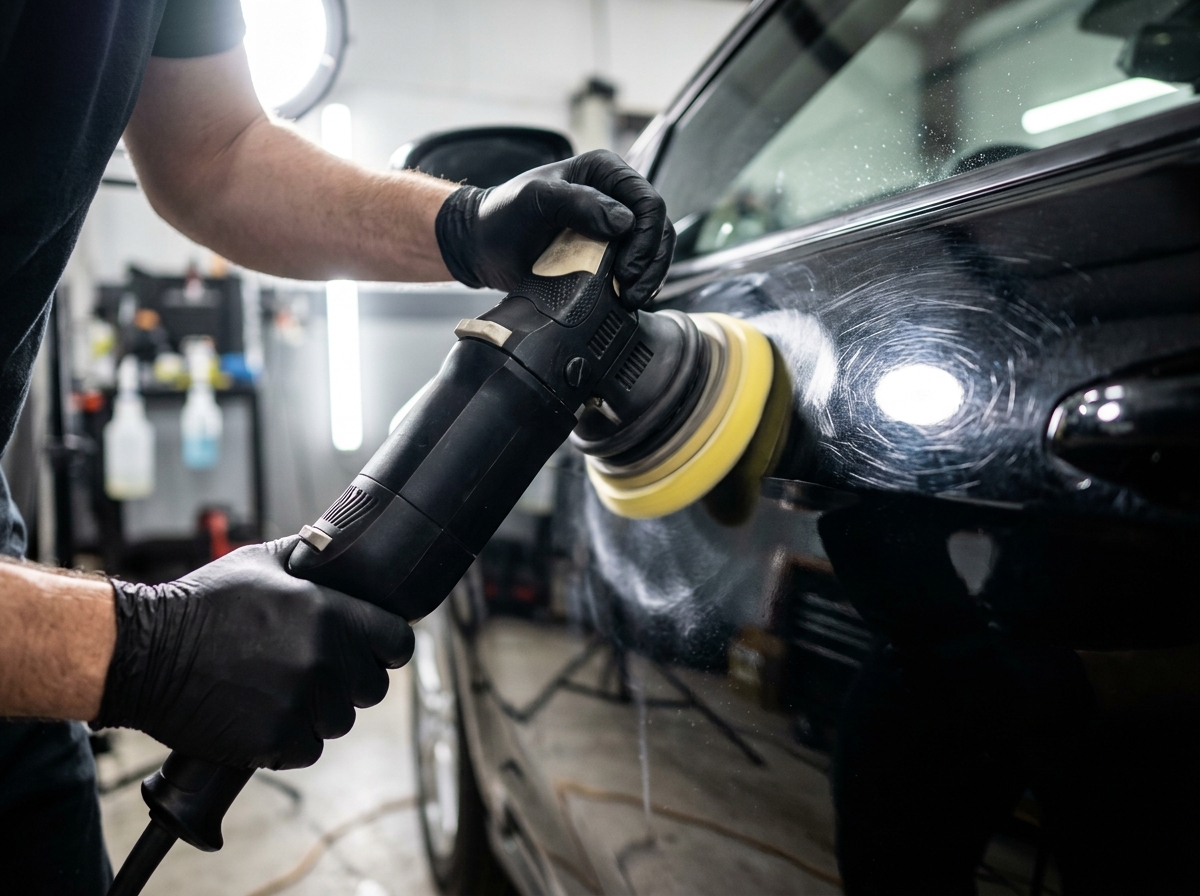
By machine (what I recommend):
- Put a few pea-sized drops of compound on the pad.
- Spread it over a small section, about 2 by 2 feet, with the machine off.
- Work at a low to medium speed with light pressure, using slow overlapping passes, side to side, then up and down.
- Stop when the compound turns clear or starts to dry.
- Wipe off the residue with a clean microfiber.
By hand:
Put compound on a foam applicator pad and rub in small overlapping circles or straight lines, with light to moderate pressure. It works for fine scratches, but it’s slower and less consistent than a machine.
Step 6: Check your work properly
Polishing oils can fill in a scratch and make it look fixed when it isn’t. Spray the panel with the 50/50 isopropyl alcohol and water mix, wipe it, and look again under direct light. If you can still see the scratch, it isn’t gone.
Step 7: Repeat, then stop
If there’s improvement, repeat the process. After two or three rounds, if the scratch is still clearly there, it has probably gone through the clear coat. Stop. Grinding away more paint to chase a deep scratch is how people ruin a panel.
Step 8: Refine and protect
Compounding can leave a slight haze, and it’s most noticeable on dark colors like the blue on the Civic. Go over the area with a soft finishing pad and fine polish to bring back the gloss, then seal it with wax or a paint sealant so the repaired area is protected.
Common questions about buffing out car scratches
Can you buff out scratches on a car yourself?
Yes, if the scratch is only in the clear coat. A DIY polish can remove light scratches, scuffs, fs and swirl marks. Deep scratches that go through to the primer or metal need touch-up paint or professional repair.
Can every scratch be buffed out?
No. If your fingernail catches hard or you can see a different color or bare metal, the damage is below the clear coat and buffing can’t fix it.
Does toothpaste remove car scratches?
I don’t recommend it. Toothpaste is a mild abrasive, but it isn’t made for automotive paint; it cuts unevenly, and it can leave a hazy patch that looks worse than the scratch. A proper polishing compound is made for the job.
Does WD-40 remove car scratches?
No. It can fill and hide a fine scratch for a short time, but that’s temporary, and it doesn’t level the paint.
Do scratch removal pens or kits work?
They mostly fill the scratch rather than remove it, so results vary and often don’t last. For clear coat scratches, polishing gives a more permanent fix. For deeper ones, a touch-up paint kit applied carefully works better than a pen.
What’s the best compound or polish for car scratches?
Start with a fine cutting compound, step up only if needed, and finish with a fine polish. The best product for you depends on your paint and the scratch, so test in a small spot before committing.
Is it better to buff by hand or with a machine?
A dual-action polisher is more effective and more consistent, and it’s safer for beginners than a rotary buffer because it’s much harder to burn through paint. Hand polishing is fine for very light scratches.
Can you damage your paint by buffing?
Yes. Too much pressure, too aggressive a pad or compound, buffing too long, or working on edges can wear through the clear coat. That’s why you should start gently, tape off edges, and stop after a few rounds.
Is it harder to buff dark paint like black or blue?
It isn’t harder to remove the scratch, but dark paint shows every flaw, so you need a finishing polish step and good lighting to get a clean look.
Does clay bar remove scratches?
No. A clay bar removes surface contamination, not scratches. Use it before polishing to give a clean working surface.
Should I wet sand a scratch?
Wet sanding is an advanced technique that removes more clear coat. I’d only consider it for stubborn scratches, and only after you’ve practiced on a spare panel or have professional guidance.
Can a scratch cause rust?
If it goes all the way to bare metal, yes. Moisture can get in, and rust can spread under the paint. Deep scratches should be sealed with touch-up paint soon rather than left alone.
How long does it take to buff out a scratch?
For a small area, expect roughly an hour once you include washing, taping, polishing, and finishing.
How do I protect the area afterward?
Seal it with a quality wax or paint sealant, wash with clean mitts and the two-bucket method, and avoid automatic car washes with stiff brushes.
When to call a professional
- The scratch is through the clear coat or down to metal.
- It’s a large area or covers multiple panels.
- You’ve tried two or three rounds with no improvement.
- The car is leased, high-value,ue or a classic, and you don’t want to risk it.
Final thoughts
The biggest lesson from my Civic repair is patience. Wash properly, test in a small spot, use the least aggressive option that works, and stop when you’ve reached the limit of what polishing can do. That approach saves your paint and gives the best results on dark colors.